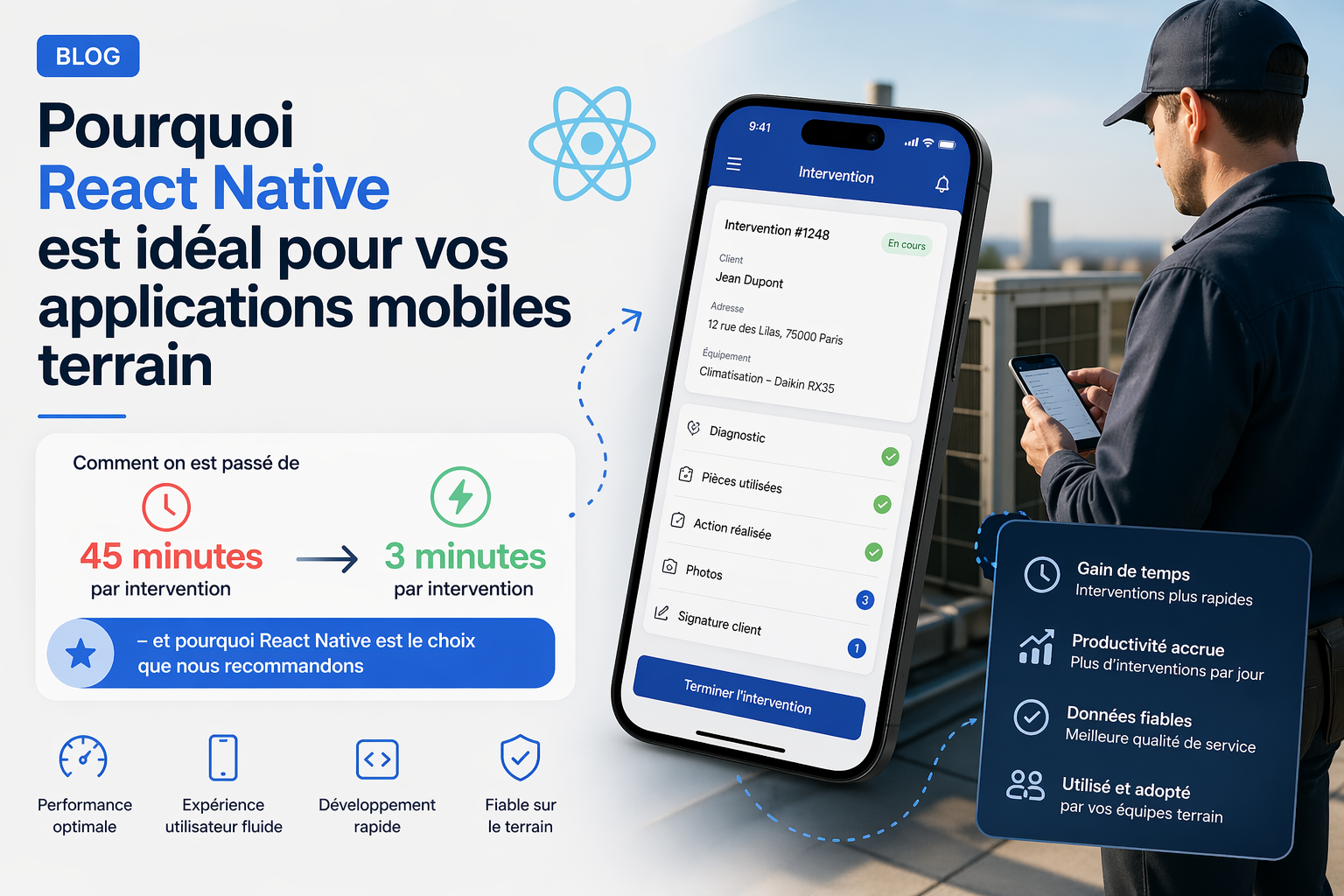
A site foreman showed me how he managed material installation before our app: photos taken on his phone, sent over WhatsApp to his supervisor, who printed them and entered the data into an Excel sheet in the evening. Each operation took around 45 minutes and accumulated transcription errors along the way. After deploying the mobile app, the same operation takes three minutes — on-site, with no internet connection.
When building a mobile application for field teams, the first technical choice is: separate native iOS/Android apps, or cross-platform? After delivering several projects for Moroccan and French clients, our answer is clear: React Native, almost every time.
React Native is one codebase for both iOS and Android. In practice, that means you don't pay for development twice, you don't maintain two separate apps, and updates roll out to both platforms simultaneously. For field teams in SMEs, this is often decisive: the budget exists for one application, not two.
Performance is close to native — unlike older WebView-based hybrid frameworks. React Native uses real native iOS and Android components, which translates to genuine smoothness in the field. A construction worker using the app outdoors with dirty hands doesn't have time for a sluggish interface.
Offline mode is often the real constraint for field applications. Warehouses, construction zones, rural areas — 4G isn't always available. React Native enables robust local sync: data is entered locally and synchronized once the connection is back. It's a feature we build into every mobile business application we deliver.
Is your field team still using WhatsApp to transmit information that should be in your system?